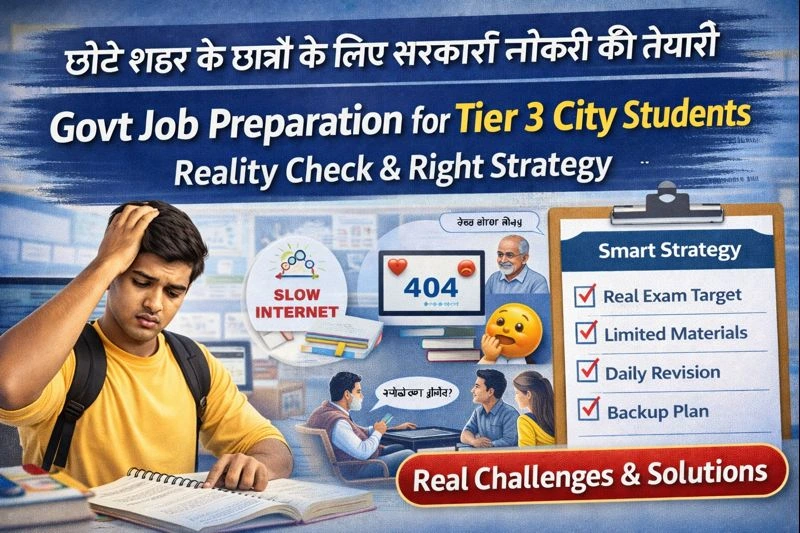
If you are preparing for a Govt Job from a tier-3 city or small town, this article is for you.
I’ve interacted with many aspirants from districts and small cities—some studying at home, some helping their families, some working part-time. Their struggle is very different from what coaching ads or topper interviews show.
This is not a motivational speech.
This is a ground-reality guide—what actually works, what doesn’t, and what mistakes tier-3 students commonly make during Govt Job preparation.
Step 1: Accept the starting gap (and stop feeling inferior)
The reality
Students from metro or tier-1 cities often have:
- Better internet
- English exposure
- Coaching access
- Peer competition
Tier-3 students often have:
- Limited guidance
- Slow internet
- Family pressure
- Fewer serious aspirants around
Why accepting this matters
I’ve seen students waste months feeling inferior instead of improving basics.
Acceptance doesn’t mean weakness—it means planning realistically.
Your goal is not to match someone else’s resources.
Your goal is to use what you have consistently.
Step 2: Coaching is not the main problem (confusion is)
A common misconception
“अगर मैं दिल्ली / पटना / लखनऊ चला जाऊँ, तो सेलेक्शन हो जाएगा।”
From experience, most failures are not due to lack of coaching, but due to:
- No fixed syllabus clarity
- Jumping between exams
- Changing teachers repeatedly
What actually helps more than coaching
- One clear exam target
- One trusted syllabus source
- One revision system
Many selected candidates I’ve seen prepared entirely from home, slowly but steadily.
Step 3: Language barrier is real—but manageable
The real issue
Tier-3 students often struggle with:
- English comprehension
- Fear of English questions
- Avoiding sections completely
Why this hurts selection
In exams like SSC, Banking, Railways:
- You don’t need fluent English
- But you must understand basic instructions and passages
Practical fix (that actually works)
From what I’ve seen:
- Start with exam-level English, not grammar books
- Read previous year questions daily
- Translate mentally at first—this is normal
Avoiding English entirely is a bigger risk than weak English.
Step 4: Internet and study material overload
The hidden problem
Tier-3 students now face the opposite problem:
- Too many YouTube channels
- Too many PDFs
- Too many “important questions”
Why this is dangerous
I’ve seen students collect materials for months but revise nothing.
A simple rule I recommend
If you can’t revise it 3 times, don’t study it once.
Pick:
- 1 book per subject
- 1 question source
- 1 revision notebook
That’s enough.
Step 5: Family pressure and silent expectations
This is rarely discussed
In tier-3 cities:
- Family expects early earning
- Relatives keep asking “कब नौकरी लगेगी?”
- Time pressure builds quietly
Why this affects Govt Job preparation
Stress leads to:
- Random exam switching
- Panic form filling
- Loss of focus
What helps (from real observation)
- Set one realistic exam cycle (1–2 years)
- Communicate clearly with family
- Keep at least one backup skill or option open
You don’t need permission—but clarity helps everyone.
Step 6: Self-study discipline matters more than intelligence
A hard truth
I’ve seen average students succeed and bright students fail.
The difference was not IQ.
It was daily routine.
A workable daily workflow (tier-3 friendly)
Example routine:
- 2–3 hours focused study
- 1 subject + revision
- 30–40 questions daily
- Weekly mock or sectional test
No fancy schedule. Just repeatable.
Common mistakes tier-3 students make (and fixes)
Mistake 1: Preparing for too many exams
Fix: Choose one primary exam, one backup only.
Mistake 2: Waiting for “perfect guidance”
Fix: Start with available resources. Improve later.
Mistake 3: Ignoring revision
Fix: Weekly revision is non-negotiable.
Mistake 4: Comparing with toppers constantly
Fix: Compare only with your last month’s performance.
Copyable checklist: Are you preparing correctly?
You can save this:
- One fixed exam target
- Limited study material
- Daily revision habit
- Weekly practice test
- English basics not ignored
- Family expectations discussed
- Backup plan exists
If 5+ boxes are ticked, you’re on the right path.
Final takeaway: Tier-3 is not a disadvantage—confusion is
From real experience, location does not decide selection.
Lack of direction does.
Tier-3 students often have:
- Fewer distractions
- Stronger motivation
- More patience
Use these strengths.
Govt Job preparation is slow, boring, and repetitive—but it rewards consistency, not privilege.
FAQs (Real doubts I hear often)
1. Can tier-3 city students really clear SSC or banking exams?
Yes. Many do. The key difference is consistency, not city size.
2. Is moving to a big city necessary?
No. It helps some, but it’s not required if you have clarity and discipline.
3. What if my English is very weak?
Start small. Don’t avoid it. Exam-level English is achievable with practice.
4. How many hours should I study daily?
Quality matters more than hours. Even 3 focused hours daily are enough if done consistently.
5. Should I prepare for state and central exams together?
Only if the syllabus overlaps. Otherwise, it increases confusion.
6. What if I fail once or twice?
That’s common. Failure is part of this journey, not a verdict.
7. Is online preparation reliable?
Yes—if you limit sources and follow a structured routine.